
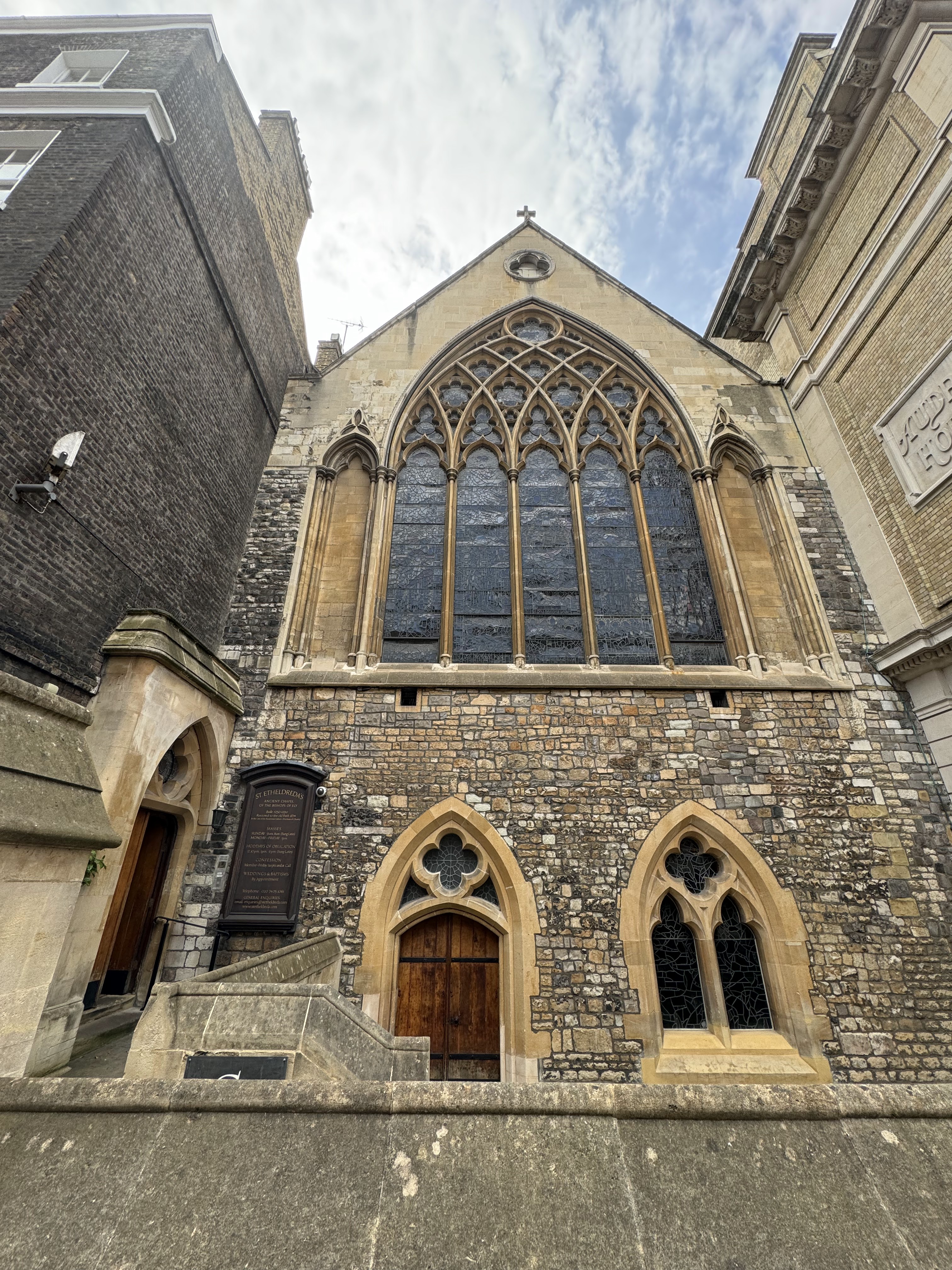
St. Etheldreda’s Church at Ely Place in London is probably my favorite church in all of London. It never fails as I walk down the (relatively) quiet, private street of Georgian terraced homes after passing the gatehouse, to be in awe and feel the excitement when I catch my first glimpse of the church. It is the oldest Catholic Church in England and one of two remaining buildings in London from the reign of Edward I.
Let’s start from the beginning…St. Etheldreda. Princess Etheldreda, daughter of King Anna, was born in 630 in the Kingdom of East Anglia. She wanted to join a convent but agreed to a political marriage as long as she could maintain her virginity. She fled back to Ely (~80 miles north of London) when her husband, King Egrith, tried to break the agreement. Here she found a religious community and built a church. After her death in 679, devotion spread with many favors attributed to her intersession. They moved her 15 years after her death and discovered her to be incorruptible. Again, in 1106 when the Normans were building the Cathedral at Ely, she was reported as incorrupt – almost 450 years after her death. You can still visit her shrine in Ely Cathedral today.

St. Etheldreda Church in London has an amazing history. It was once the chapel to Ely Palace, the Bishops of Ely’s London residence starting in the 13th Century. The Bishops of Ely were one of the premier bishoprics in the land and provided counsel to the king, therefore needed a place in town to stay. The palace spread over 58 acres of land and included orchards, vineyards, gardens and crop lands.
After the Reformation, St. Etheldreda’s became Church of England and mass was abolished, replaced by the Book of Common Prayer. Mass was restored under Queen Mary who tried to bring England back to the Catholic Church. When Mary died and Elizabeth became queen, Elizabeth could not uphold Catholic teaching because that would make herself illegitimate. Mass again was abolished and Elizabeth I along with William Cecil began the destruction of the Catholic Church in England. All Catholic priests were hunted and to hear mass became a hanging offence. In 1620, the Spanish Ambassador moved into Ely Place, and because it was now considered Spanish land, mass was said once more in St. Etheldreda Church. Despite the dangers of hearing mass, people flocked to the church. During the Civil War in 1642, the house and chapel became a prison and hospital. Then it was almost destroyed in the Great Fire of London in 1666 which burned almost two-thirds of London, however as the fire drew near St. Etheldreda’s, the winds changed and the church was saved. For the next 100 years, Ely Place was left to deteriorate until an act from Parliament in 1772 allowed the property to be sold. The new owner, Charles Cole, demolished everything except for the chapel, kept to serve as a place for Anglican worship, and built the present day Ely Place. In 1820 it passed to the National Society for the Education of the Poor in an attempt to attract immigrants in the area, but the church eventually closed.

In 1829, the Emancipation Act passed and for the first time in 300 years, Catholics were free to hear mass without fear of imprisonment. Over the next several decades, the chapel and area surrounding St. Etheldreda’s became part of the slums and places nearby are mentioned in Charles Dickens’ works of David Copperfield, Oliver Twist, Great Expectations, and Little Dorrit. It wasn’t until 1873 when Cardinal Henry Manning chose Father Lockhart of the Rosminians order to serve in the slums of Holburn. (Note: Father Lockhart’s conversion is said to have convinced the now Saint John Henry Newman to convert to Catholicism.) Father Lockhart received word that the chapel of St. Etheldreda’s would be put up for auction where they were bidding against the Welsh Episcopalians. During the auction, the Welsh contingent made a mistake, thinking Father Lockhart’s agent was theirs, and they stopped bidding. St. Etheldreda’s was Catholic once more!

After the purchase, effort immediately went underway to prepare the crypt for public use while the church above was being restored to its original 13th-century design. Saint Bridgets in the Crypt was open for worship in June 1876 with the Cardinal attending along with the Duke of Norfolk and other well-known Catholics. Father Lockhart received from Vincent Harding a relic of the hand of St. Etheldreda and is placed in the chapel where it is to this day. On June 22, 1879, the ceremony of the reconciliation of the desecrated church was performed and the following day, St. Etheldreda’s feast day, mass was celebrated.
Because of these historical connections, inside St. Etheldreda’s today is a place to honor the English martyrs. 8 statues of these martyrs run along each side of the church – attending mass you are surrounded by these courageous people and feel as if they are with you. The stained glass windows are beautiful, especially the one at the back which commemorates the first martyrs at Tyburn. I remember the first time I attended mass at St. Etheldreda’s before I understood the significance and history of what this church captures. I felt an overwhelming sense of joy but tinged with sadness and pain, leading me to become overwhelmed several times. To this day, I look forward to these emotions when I enter the church as it makes me feel connected to those who held onto their faith.


Leave a Reply