
Explore. Discover. Pray. Play.
Looking for a way to explore London that’s fun, faith-filled, and perfect for kids – and their grown-ups too? This unique guide invites Catholic families to step into the stories of saints, uncover hidden treasures, and turn a day in London into a holy adventure.
London is packed with stories, but some of the best ones are hidden in plain sight. This isn’t just a city of palaces and red buses; it’s a place where saints once walked, where chapels survived in secret, and where reminders of courage and faith are tucked between coffee shops and cobblestones.
This guide is for families who want to explore together – to pray a little, learn a lot, and discover how faith is woven into the heart of London. Whether it’s whispering a prayer in a medieval crypt, spotting a hidden relic, or learning about a teenager who’s already on the path to sainthood, each stop opens a new doorway into our Catholic story.
It’s part scavenger hunt, part pilgrimage, and all about helping you see London through the eyes of wonder, faith, and curiosity. Let’s go!
These are just the beginning – stay tuned for more locations!
1. Westminster Cathedral
Step off busy Victoria Street and you’re suddenly inside London’s own slice of early-Christian Constantinople. With red-and-white striped bricks, vaulted domes, and gold glinting from half-finished mosaics, Westminster Cathedral feels ancient, peaceful, and alive all at once. Kids are usually stunned by the height; grown-ups, by the hush. And if you’re anything like me, you’ll want to wander slowly, just to take it all in.
This cathedral is the mother church for Catholics in England and Wales, built in the 1890s as a bold symbol that Catholicism was finally free again after 300 years of persecution. Its design shocked the Victorians: bold Byzantine domes, soaring brick towers, and chapels bursting with colour. Architect John Francis Bentley died before it was completed, but he left plans so that each generation could help finish it – a living work of art. During WWII, its bell tower was like a lighthouse for Londoners walking blacked-out streets, and Masses continued even during air raids.
Today, it’s still growing, still welcoming, still whispering that holiness is real — and it belongs here.
🕵️♀️ Seek & Find:
- Spot the green marble pulpit – how many lion paws are holding it up?
- Find a saint holding a palm branch (that means they were a martyr).
- In St Andrew’s Chapel floor, hunt for the tiny sea creature.
- Visit St John Southworth’s glass tomb and say a quiet hello.
- How many side chapels can you count along the main walls?
✨ Mini Mission: Pop into the Lady Chapel, light a candle, and pray a Hail Mary for someone who needs a little extra courage today.
🤫 Little-Known Facts:
- The campanile (bell tower) is taller than Westminster Abbey’s roof – and you can take the lift to the top!
- Marble from 24 different countries was used to build the interior.
- During WWII, priests used blackout lamps so Masses could continue without lighting up the cathedral for enemy bombers.
👉 Download & Print the Coloring Page: keep the adventure going at home or on-the-go.


2. St Etheldreda’s Church (Ely Place)
This one feels like a secret level you unlock in a game. You’re walking through busy Holborn, and suddenly you duck down a quiet, gated side-street… and there it is. A medieval chapel glowing with stained glass, candles flickering in the hush, and the sense that something holy has been happening here for a very long time.
St Etheldreda’s was built around 1290 as the private chapel of the Bishops of Ely (yes – the same Ely with the cathedral and the marshes!). They even grew strawberries here in their London gardens. During the Reformation, the chapel was saved by becoming part of a private home. Then in the 1600s, it became the Spanish Embassy Chapel, one of the only places in England where public Mass was still allowed. After riots, near-demolition, and serious Victorian neglect, it was rescued in 1873 and restored to Catholic worship by the Rosminian Fathers.
Now it’s one of the most atmospheric churches in London – a place of hidden light, quiet courage, and stained glass that practically sings.
🕵️♀️ Seek & Find:
- Look up at the great east window: what colour is St Etheldreda’s cloak?
- Find the dragon hidden in the stained glass.
- Hunt for a palm branch and sword together in one window — signs of a martyr.
- How many different shields or crests can you spot?
✨ Mini Mission: Kneel in the crypt chapel and pray one decade of the Rosary for Christians who still have to worship in secret today.
🤫 Little-Known Facts:
- The church holds a relic, a bone from the incorrupt hand of St Etheldreda, gifted by the Duke of Norfolk during the 19th-century restoration.
- The huge west window honors the Martyrs of the English Reformation, including Carthusian monks from nearby Charterhouse, shown under a medieval gallows.
- Eight full-size statues of English martyrs line the nave, including St Anne Line, St Edmund Gennings, and St John Houghton, each one a silent reminder of courage.
👉 Download & Print the Coloring Page: grab your crayons, and keep the memory going.


3. Charterhouse (Museum & Grounds)
This place has layers. From plague pit to monastery, Tudor mansion to almshouse – Charterhouse is like flipping through a history book and finding saints in the margins. Tucked behind iron gates just steps from the Barbican, it’s peaceful, moving, and full of stories most Londoners don’t even know.
In 1371, Carthusian monks founded their Charter House on this land – a former burial ground for victims of the Black Death. They lived in deep silence, each with their own cell and garden, devoting their lives to prayer. But when Henry VIII split from Rome, the monks refused to sign the oath declaring him head of the Church. One by one, they were arrested, tortured, and martyred – some at nearby Tyburn.
After the monastery was dissolved, the property became a grand home for wealthy nobles. In 1611, it was bought by Thomas Sutton, a generous (and very rich) layman, who turned it into a hospital and school for poor boys. The school moved to the countryside in the 1800s, but the almshouse, now called the Brotherhood of Charterhouse, still welcomes retired men and women to live in community here.
It’s quiet, beautiful, and humbling – a place to reflect on what it means to give everything to God.
🕵️♀️ Seek & Find:
- How many dog heads can you find carved around the property? Look up!
- Count the chimneys from the main courtyard – every monk had their own fireplace.
- Spot Thomas Sutton’s fox badge carved into the stone above a doorway.
- Look for some bones, a reminder of the Black Death burial ground.
✨ Mini Mission: Be silent for one full minute while walking through the courtyard or garden. Then whisper a prayer asking God to speak to your heart in the stillness.
🤫 Little-Known Facts:
- Three Carthusian martyrs from Charterhouse, St John Houghton, St Robert Lawrence, and St Augustine Webster, are among the 40 Martyrs of England and Wales.
- The monks never spoke out loud. Meals, prayers, everything was done in total silence.
- Queen Elizabeth I stayed here just before becoming queen. Years later, James I also visited.
👉 Download & Print the Coloring Page: bring the courtyard to life at home with your own colors and creativity.


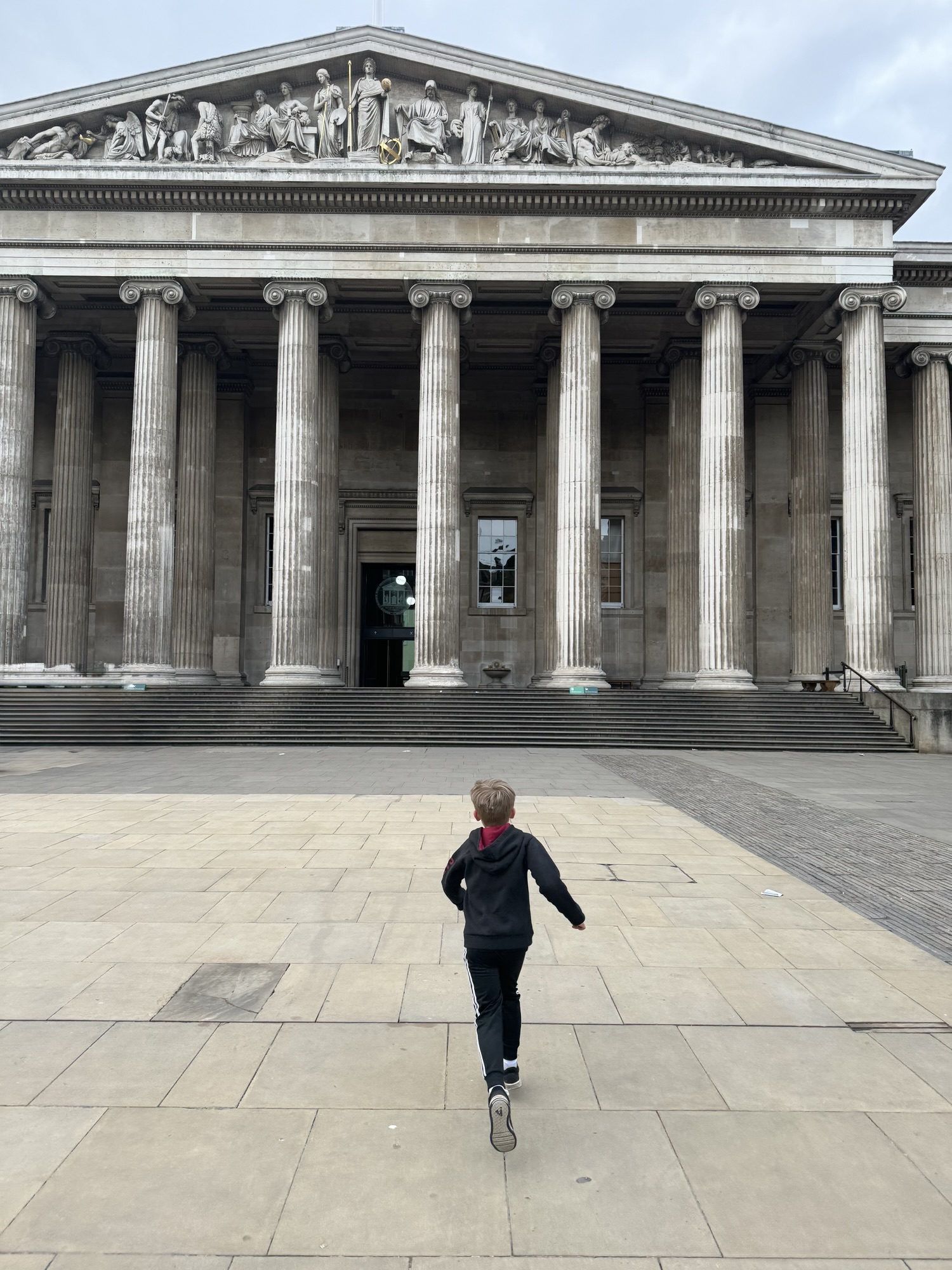
4. British Museum
This place is basically the world’s attic — and it’s absolutely brilliant. You walk in and boom! there’s a giant Egyptian statue, a Viking hoard, Roman mosaics, and ancient tablets that line up with Bible stories. There’s something jaw-dropping around every corner and hidden in plain sight are incredible traces of faith, early Christianity, and even the lives of saints.
Founded in 1753 with the collections of Sir Hans Sloane (a Catholic, by the way!), the British Museum was the world’s first free public museum. It’s survived everything from 19th-century crowds to WWII bombs, and it now houses more than eight million objects. It’s not a Catholic museum, but if you know where to look, you’ll find pilgrim badges, saint relics, Bible-era inscriptions, and early Christian symbols that prove the Church has always been part of the human story.
It’s the kind of place where you can lose track of time – and that’s a good thing. History comes alive here. So does faith.
🕵️♀️ Seek & Find:
- Spot the early Christian fish symbol in the Roman Britain gallery (Room 49).
- Hunt for a pilgrim badge of St Thomas Becket (Room 2a).
- Look for the wall carving of an Assyrian army attacking a city – it’s Lachish from 2 Kings 18. How many archers can you count?
- Find the Black Obelisk of Shalmaneser III – King Jehu of Israel is bowing! What’s he holding?
- Search for a clay tablet with a Flood story that sounds a lot like Noah’s Ark (Room 55 — the Epic of Gilgamesh).
👀 Tip: Some objects are on loan or being restored — if you don’t see one, ask a gallery staff member where it is!
✨ Mini Mission: Gather under the glass roof in the Great Court. Take a moment to pray: “Thank you, God, for the gift of history. Help me to see Your story in every time and place.”
🤫 Little-Known Facts:
- The Hinton St Mary Mosaic from Dorset holds the earliest known image of Christ in Britain – complete with the Chi-Rho symbol.
- During WWII, the museum’s treasures were stored in Welsh caves to keep them safe from bombs.
- The museum still follows its original rule: “Free to all curious and studious persons.”
👉 Download & Print the Coloring Page: create your own museum masterpiece with Christian symbols, artifacts, and ancient history.


5. Tower of London & Tower Hill
There’s nowhere else quite like it. Castles, crowns, ravens, and… martyrs. The Tower of London is one of the most iconic spots in the city, and once you know the Catholic story here, it changes everything. You’re not just walking through an old fortress, you’re following in the footsteps of saints who stood up for truth, even when it cost them everything.
Built by William the Conqueror in 1078, the Tower has done it all: royal palace, prison, treasury, zoo, mint – and a place of profound suffering. During the Reformation, it became the final holding place for martyrs like St Thomas More, St John Fisher, and St Philip Howard. From here, they walked to Tower Hill where they laid down their lives. And inside the Chapel of St Peter ad Vincula, their bones still rest beneath the stones, quietly proclaiming the faith they never renounced.
The Beefeaters might give you the royal version of events, but keep your ears open, there’s a deeper story of faith here that’s waiting to be uncovered.
🕵️♀️ Seek & Find:
- Count the ravens – legend says the kingdom falls if they ever leave!
- At Tower Hill (across the street from Tower of London), read aloud one name from the martyr memorial plaque.
- Look for prisoner carvings in the Beauchamp Tower – can you find “IHS,” the sacred monogram of Jesus?
- Hunt for the initials “A” and “H” carved together, that’s St Philip Howard’s cipher.
- Can you spot the etchings made by St Henry Walpole (hint – it’s his name!)?
✨ Mini Mission: Stand quietly at Tower Hill. Imagine the walk these saints made – and pray for courage to stand for your faith, even when it’s not easy. Ask St Thomas More and the Tower martyrs to pray for you and your family.
🤫 Little-Known Facts:
- The Chapel of St Peter ad Vincula holds the remains of St Thomas More, St John Fisher, and others, buried without headstones, but not forgotten.
- St Thomas More wrote moving letters to his daughter Meg from his prison cell here.
- Since the 1300s, the Tower has held a nightly “Ceremony of the Keys” to lock the gates. You can still go and watch it today – just book ahead!
👉 Download & Print the Coloring Page: make your own fortress and remember the brave souls who stood strong inside these walls.


6. Tyburn Gallows Site (Marble Arch)
Right in the middle of traffic, shops, and the rush of Oxford Street lies one of London’s most sacred, and most overlooked, spots. Today it’s just a round plaque near Marble Arch, but centuries ago this was the site of the infamous Tyburn Tree: a triple gallows where over 100 Catholic martyrs were executed during the Reformation.
It’s hard to imagine it now with buses zooming by and people holding shopping bags, but here, priests were hanged for saying Mass, laypeople for hiding them, and brave witnesses chose eternal life over comfort. And incredibly – they died with joy. Many forgave their executioners. Some sang hymns. Some prayed aloud for their enemies. They believed Heaven was waiting, just beyond the scaffold.
There’s no big sign or souvenir stand here. Just a quiet circle of stone underfoot and a deep invitation to remember.
🕵️♀️ Seek & Find:
- Cross carefully to the traffic island and find the round memorial stone.
- Can you find the cross carved into its center?
- What’s around it now and how does it feel knowing what once happened here?
- Look for the three trees nearby, do they remind you of anything?
✨ Mini Mission: Stand together as a family around the plaque. Hold hands. Say one Our Father for the Tyburn martyrs, and then a thank-you prayer for the freedom we have to worship today.
🤫 Little-Known Facts:
- The “Triple Tree” gallows could hang up to 24 people at once.
- Executions at Tyburn were public spectacles, but Catholic martyrs often drew silence and awe from the crowds by their courage.
- Just five minutes away, the Tyburn Convent has kept 24-hour Eucharistic adoration going since 1903, a living legacy of the martyrs who died here.
👉 Download & Print the Coloring Page: honour the martyrs with art and prayer at home.


7. Our Lady of Dolours, Chelsea (Carlo Acutis Baptism Church)
It’s easy to walk right past this red-brick church near Chelsea without realising how special it is, but step inside and you’re standing where Blessed Carlo Acutis was baptised. Before he became known around the world as the teen saint of the internet, before the Eucharistic miracle website, before his beatification, Carlo began his journey to sainthood right here in London.
He was born just down the street in 1991 and brought to this very font by his parents. The church itself, opened in 1874 by the Servite Order, has always had a strong devotion to Our Lady of Sorrows – you’ll see her statue with seven swords in her heart as soon as you walk in.
Today, families come to pray in the same spot where Carlo’s life of holiness began, to be inspired not by stained glass from centuries ago, but by a modern teenager who reminds us that sainthood isn’t about age, robes, or titles – it’s about saying “yes” to God, every day.
🕵️♀️ Seek & Find:
- Find the baptismal font near the sanctuary – this is where it all began for Carlo.
- Spot the statue of Our Lady of Sorrows – how many swords can you count?
- Can you find a relic or image of Blessed Carlo?
- Look for the golden tabernacle – what shape is it?
- Count the medallions along the nave that show Mary’s seven sorrows.
✨ Mini Mission: Say a prayer asking Blessed Carlo to help you use technology for good – to be brave, kind, and faithful in the small things, just like he was.
🤫 Little-Known Facts:
- Carlo was baptised here on 23 May 1991, not long after his birth.
- The Servite Order, who care for the church, was founded in 1233 and has always honoured Mary’s sorrows as a path to deeper compassion and trust.
- You can also visit a shrine to Carlo at Corpus Christi Church in Covent Garden, where his legacy continues to inspire pilgrims of all ages.
👉 Download & Print the Coloring Page: colour Carlo’s church and remember that holiness starts with everyday choices.


Final Blessing & What’s Next
Whether this was your first family pilgrimage or just one stop on a longer faith adventure, I hope this guide helped you see London in a whole new way – not just as a city of red buses and royal guards, but as a sacred place where saints walked, prayed, and witnessed with courage. Every chapel, crypt, and street corner holds a story waiting to be discovered together.
If you’ve still got some energy left (or need a few lower-key places to stretch your legs between ice creams and Tube rides), check out the Walking Wonders companion guide – it’s full of faith-filled discoveries hiding right in plain sight, from secret ruins to surprising plaques. Keep exploring, keep praying, and let the saints of London walk with you.
To help you keep the adventure going, we’ve created some fun companion resources just for families:
- 🎨 Coloring pages for each site in cartoon-style line art, so your kids can remember what they saw as they colour. Links to each are found at the bottom of each location.
Print them out, pack them in your bag, and let your London pilgrimage live on in prayer, in play, and in memory.
Happy exploring and may the saints of London walk with you!
Leave a Reply