
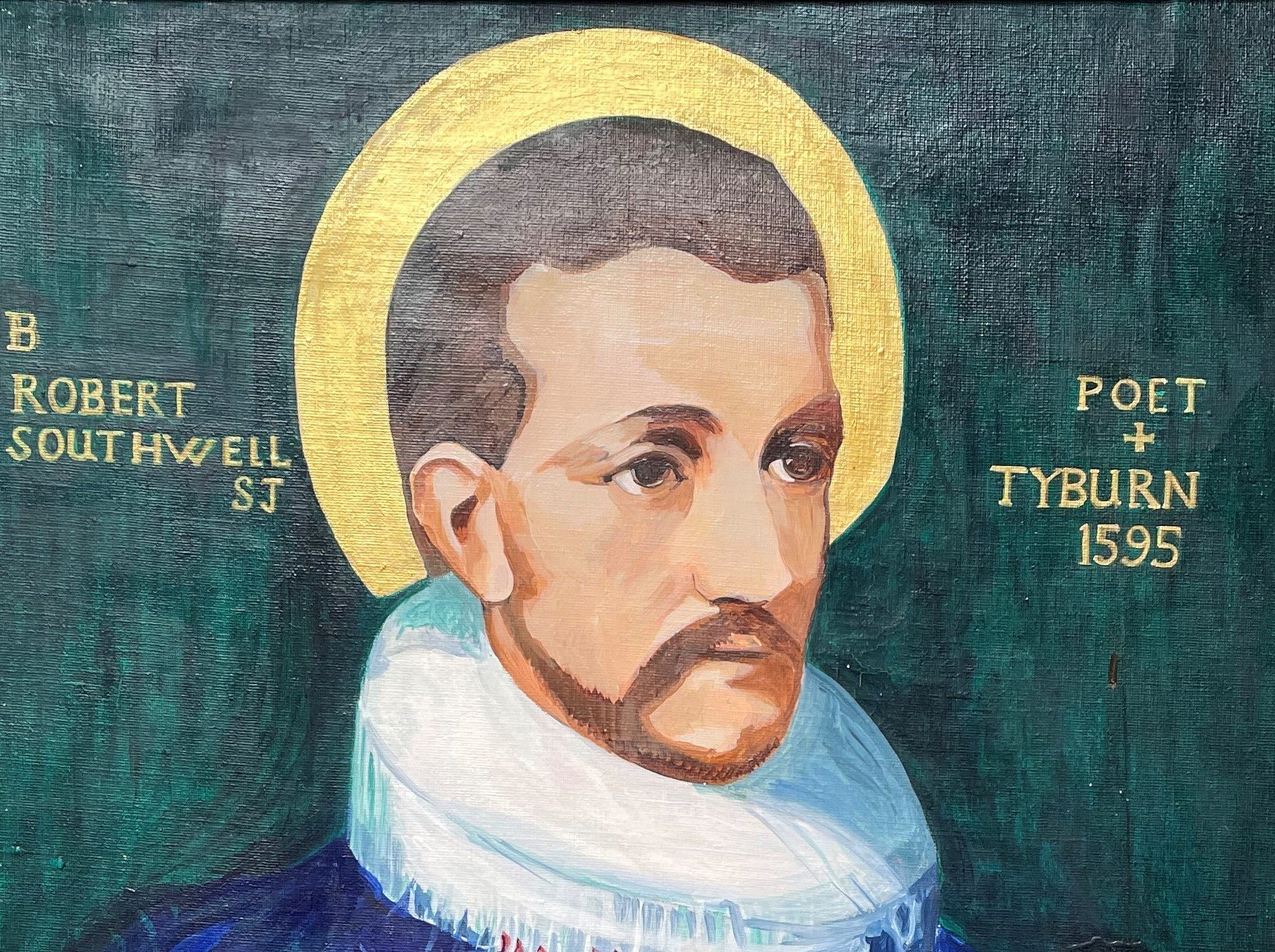
“God is my gift, Himself He freely gave me,
God’s gift am I, and none but God shall have me.” – Robert Southwell, ‘The Nativity of Christ’
Some saints lived long, peaceful lives, but St. Robert Southwell? He was a fearless Jesuit priest, a secret missionary, and an incredibly talented poet—all during a time when being Catholic in England could get you killed. His story is one of courage, faith, and the power of words, and you can still visit places connected to his life today.
From Norfolk to the Jesuits
Robert Southwell was born around 1561 in Norfolk, into a Catholic family at a time when practicing the faith in England was becoming increasingly dangerous. Like many young men from gentry Catholic families, he was sent abroad for his education. He ended up in France, then Rome, where he joined the Jesuits in 1580 and was ordained a priest in 1584.
Knowing full well what he was getting into, he returned to England in 1586 as a Jesuit missionary. His job? To minister to Catholics in hiding, celebrate Mass in secret, and offer encouragement to those suffering under Elizabeth I’s harsh anti-Catholic laws.
Secret Missions and Famous Friends
For six years, Southwell operated in and around London, often staying in the homes of wealthy Catholic families who risked everything to support the underground Church. One of his most important protectors was Anne Howard, Countess of Arundel, the wife of St. Philip Howard, Earl of Arundel—who was locked up in the Tower of London for his faith. Southwell served as her chaplain, offering Mass and writing much of his poetry under her protection.
He also became a writer of letters and devotional works that circulated secretly among Catholics. He had a gift for words, and his works weren’t just spiritual—they were beautifully written. His poetry, in particular, is filled with emotion, faith, and deep theological reflection.
His Greatest Works
Southwell wasn’t just a priest; he was one of the most gifted poets of his time. His works blended deep spirituality with striking imagery, offering both comfort and challenge to his readers.
Poetry
“The Burning Babe” – Perhaps his most famous poem, this vivid Christmas meditation presents the Christ Child as a burning flame of divine love. The poem was so admired that even the great poet Ben Jonson said he would have given up many of his own works just to have written it. The opening lines are unforgettable:
“As I in hoary winter’s night stood shivering in the snow,
Surprised I was with sudden heat, which made my heart to glow;
And lifting up a fearful eye to view what fire was near,
A pretty babe all burning bright did in the air appear.“
“St. Peter’s Complaint” – One of his most famous works, it is a long poem reflecting on St. Peter’s remorse after denying Christ. Written in the style of a lament, it captures the deep sorrow and longing for forgiveness that so many believers can relate to. It was widely read in England and became one of the most popular Catholic poems of the time.
“Upon the Image of Death” – A sobering reflection on the fleeting nature of life and the importance of preparing for eternity. Southwell didn’t shy away from the reality of death, but he framed it as a gateway to something greater.
“New Heaven, New War” – This poem portrays the Nativity as a battlefield, where Christ comes into the world to fight against sin and death. It’s a powerful take on the Christmas story that highlights the cosmic struggle between good and evil.
“Times Go by Turns” – A meditation on how fortune changes, with good and bad times cycling through life. It’s an encouraging piece that reminds us that suffering won’t last forever:
“Not always fall of leaf nor ever spring,
No endless night nor yet eternal day;
The saddest birds a season find to sing,
The roughest storm a calm may soon allay.“
Prose
- An Epistle of Comfort – Written to Catholics suffering persecution, this letter encouraged them to stay strong in their faith despite imprisonment, torture, and execution.
- Mary Magdalen’s Funeral Tears – A beautifully written reflection on repentance and divine mercy, using the story of Mary Magdalene’s conversion as an example of God’s boundless forgiveness.
- A Short Rule of Good Life – A practical guide for living a devout Catholic life in difficult times, filled with wisdom and advice on how to stay faithful under persecution.
Southwell’s writing was more than just poetry—it was a source of strength for Catholics in a hostile land. His words, carefully chosen and full of meaning, still resonate centuries later.
Betrayal, Torture, and Martyrdom
For six years, Southwell worked in secret, ministering to England’s persecuted Catholics. His mission came to an abrupt end in 1592, when he was betrayed by Anne Bellamy, a Catholic woman who had been imprisoned and pressured into setting a trap for him. She lured him to her family’s home under the pretense of receiving the sacraments, but when he arrived, Richard Topcliffe, Queen Elizabeth’s chief priest-hunter, was waiting.
Taken to Topcliffe’s private prison, Southwell was interrogated but refused to betray fellow Catholics. After enduring months of harsh treatment, his father petitioned Queen Elizabeth for better conditions. He was transferred to the Tower of London, where he remained for over two years in solitary confinement. Despite the isolation, he continued to write, producing some of his most powerful poetry, later published as St. Peter’s Complaint.
On February 20, 1595, Southwell was tried at Westminster Hall. He openly admitted to being a Catholic priest but denied any involvement in treason. As expected, the court found him guilty of high treason, the standard charge for Catholic priests under Elizabethan law.
He was taken to Tyburn, where he was executed at the age of 34. His unwavering faith in the face of suffering and death left a deep impression on those who witnessed his final moments.
Where to Find His Story Today
If you want to trace Southwell’s journey, here are a few places to visit:
- Tyburn Convent (London) – Near the site where he was executed, the convent houses relics of the English martyrs.
- Tower of London – Southwell was imprisoned in the Salt Tower and later in the infamous Little Ease.
- Arundel Castle (West Sussex) – Home of Anne Howard, Countess of Arundel, who sheltered Southwell.
- Harrow on the Hill (London) – Some believe Southwell spent time here in secret.
- St. Margaret’s Church, Westminster – Originally, his body was buried here after his execution.
Legacy and Canonization
Southwell’s legacy lives on, not just as a martyr but as one of the great poets of Elizabethan England. His influence can be seen in the works of later writers like John Donne and Gerard Manley Hopkins, and his poetry is still studied today.
In 1970, he was canonized as one of the Forty Martyrs of England and Wales, and his name is honored in churches and schools across the UK. His feast day is celebrated on February 21.
His life is a powerful reminder of the risks Catholics took to keep their faith alive in England—and how words can be just as powerful as actions.


One response to “St. Robert Southwell: The Priest Poet Who Died for His Faith”
-
[…] Learn more about St. Robert Southwell → […]
Comments
One response to “St. Robert Southwell: The Priest Poet Who Died for His Faith”
-
[…] Learn more about St. Robert Southwell → […]
Leave a Reply to The 40 Martyrs of England and Wales: Faith Under Persecution (Part 2) – Hidden CatholicCancel reply