
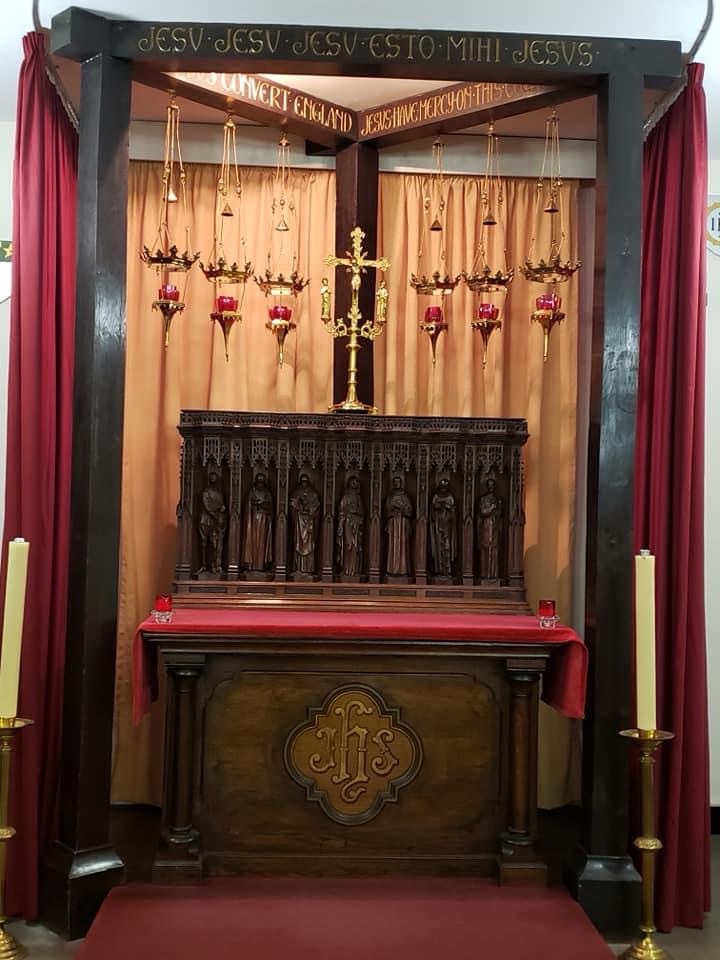
Just steps away from the bustling traffic of Marble Arch and the green expanse of Hyde Park lies one of London’s most powerful yet little-known Catholic sites: Tyburn Convent.
At first glance, it’s easy to miss. A quiet brick building with a modest sign, tucked behind iron railings—yet within its chapel and crypt lies a story that shaped the faith of a nation.
The moment you step through its doors, the atmosphere shifts. A reverent stillness settles around you, inviting reflection and awe—a sense that you are standing on sacred ground, touched by the blood and prayers of centuries.
The Martyrs of Tyburn
Between 1535 and 1681, over 300 Catholics were executed during the English Reformation, with 105 martyred at the infamous triple gallows that once stood just yards from where the convent is today. Among them were priests, religious, and lay faithful—people who refused to renounce their faith in the face of persecution.
Though the Tyburn Tree itself is long gone, a small plaque surrounded by three trees on a traffic island down the road marks the approximate site of the original gallows. Standing there, it is sobering to imagine the cheers of the crowds, the public executions intended as spectacles of fear, and the quiet courage of those who climbed the scaffold for love of Christ.
Their legacy of courage and conviction echoes through the walls of the convent, which now stands as both a shrine and a living monastery.
A French Nun’s Vision
The story of the convent itself begins not in London, but in France. Mother Marie-Adèle Garnier, a devout Frenchwoman, founded the Congregation of the Adorers of the Sacred Heart of Jesus of Montmartre in Paris. In the early 20th century, anti-religious laws forced many religious orders to flee France. Mother Garnier and her small community arrived in London in 1901, and she felt drawn to the site of the Tyburn Tree.
She believed the place where so many had shed their blood for Christ should be redeemed and sanctified through perpetual adoration and prayer. In 1903, the sisters established Tyburn Convent, just down the street from the place of execution. It would become both a memorial to the martyrs and a new spiritual home.
Perpetual Adoration & Daily Life
To this day, the nuns of Tyburn live a monastic life centered around the Eucharist. Their primary apostolate is Perpetual Adoration—they maintain an unbroken vigil before the Blessed Sacrament, day and night. The silence of their lives speaks volumes in a city that never stops moving.
The sisters also take time for hospitality. Visitors can attend daily Mass, join them for part of their prayers, or arrange guided visits of the Martyrs’ Crypt. Some of the sisters also speak at events or host retreats, quietly continuing the work of evangelization through presence, witness, and prayer.
The Martyrs’ Crypt
Beneath the chapel is the Martyrs’ Crypt, a small but profoundly sacred space that preserves the memory of the English Martyrs.
How the Relics Came to Tyburn
When Tyburn Convent was founded, the sisters were committed to honoring the English Martyrs not only through prayer, but also by preserving tangible links to their sacrifice. Many of the relics were carefully collected from Catholic families who had secretly safeguarded them during the centuries of persecution. Others were donated by religious communities and historians who recognized Tyburn as a fitting spiritual memorial. Some relics were even gifted by the Vatican, affirming Tyburn’s role in safeguarding the martyrs’ legacy. Each relic was reverently brought to the convent, where it continues to inspire devotion and awe among visitors today. Here you’ll find:
- First-class relics of many of the martyrs who died at Tyburn, including fragments of bone, clothing, and even devotional articles linked to saints like St. Oliver Plunkett and St. Edmund Campion.
- A replica of the Tyburn Tree, the triple gallows where executions were carried out, is the centerpiece over the altar, framed by the soft glow of votive candles.
- Paintings, quotes, and images showing the last moments and words of some of these martyrs.
- Coats of arms around the walls representing the religious orders and households of those who died for their faith.
The space is intimate, the air thick with the presence of prayer and sacrifice. Many visitors describe feeling a tangible closeness to the martyrs—a communion of saints made palpable in stone and silence.
Stained Glass Windows: A Hidden Gem
One of the most beautiful and often-overlooked features of the crypt are the stained glass windows. Each window is dedicated to a particular English martyr and depicts scenes from their life and death with rich color and exquisite detail. You’ll see St. Margaret Clitherow holding her rosary, St. Ralph Sherwin in his cassock, St Edmund Campion making the first pilgrimage to Tyburn Gallows, and even scenes of imprisonment and martyrdom—windows that seem to glow with the spirit of the martyrs they honor.
The windows serve not just as decoration but as visual storytelling—a luminous reminder of the ultimate price paid for the gift of faith.
Why This Place Matters
What I love most about Tyburn is that it feels like a quiet secret in one of the busiest parts of the city. You could walk past it dozens of times without knowing what’s inside. But for those who step through its doors, it’s like entering a sacred space carved out of time.
Tyburn Convent stands as a bold witness to the faith that once had to be hidden. It invites each visitor to pause, to remember, and to be changed. It is a place of awe, reverence, beauty, and profound historical depth—where the martyrs are not just remembered, but venerated and spiritually present.
Here, faith was tested and triumphed. Here, ordinary men and women chose Christ over comfort, truth over safety. Their witness still calls out to us today, inviting us to deeper courage, steadfast hope, and a living, breathing faith.
If you visit, come with a heart ready to listen—not just to the whispers of history, but to the quiet call of grace still alive in these sacred walls.
Planning Your Visit
Visitors are welcome at Tyburn Convent, but the crypt can only be visited by prior appointment. You can find more information on Tyburn Convent’s website, or better yet – contact me and I’ll schedule it for you and take you on a tour!


Leave a Reply