
“Fawning fawning crocodiles
Days and days came round about
With tears to put her candle out;
They wound their winch of wicked smiles
To take her; while their tongues would go
God lighten your dark heart — but no,
Christ lived in Margaret Clitheroe.”
– ‘Margaret Clitheroe’, by Fr. Gerard Manley Hopkins
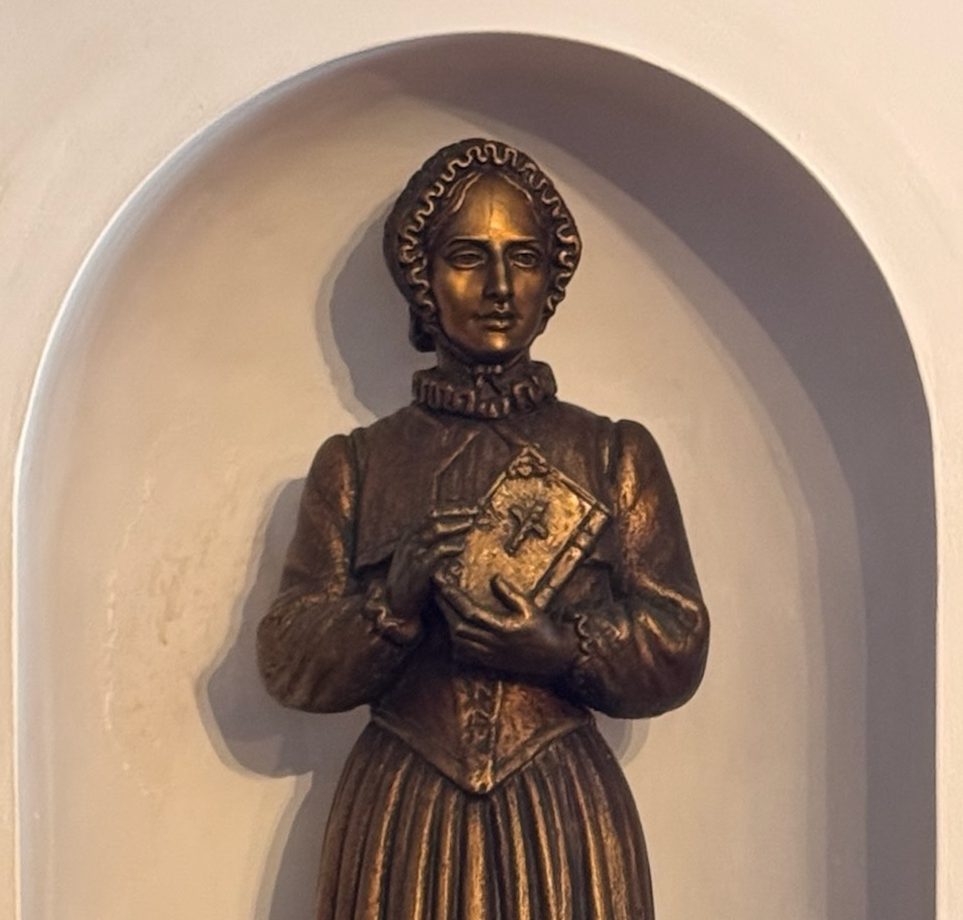
Today we celebrate the feast day of St. Margaret Clitherow—wife, mother, convert, and martyr—one of England’s most extraordinary Catholic witnesses. Known as the Pearl of York, her story is one of deep personal faith, courage in the face of persecution, and ultimate sacrifice.
Earlier this month, I had the chance to visit York for my birthday—a city soaked in medieval charm and sacred Catholic history. As I wandered the narrow lanes and stood in the very places where Margaret lived, prayed, and died, I felt an incredible closeness to her. There’s something powerful about walking where saints once walked. Her presence still lingers in the cobbled streets and stone walls, whispering her quiet defiance and radiant trust in God.
Why She Is Called the Pearl of York
St. Margaret Clitherow is lovingly known as the Pearl of York, a title that speaks to her immense spiritual value, her radiant witness, and her resilience under pressure. Just as a pearl is formed inside an oyster through layers built up in response to irritation or pain, Margaret’s sanctity emerged through layers of quiet defiance, steadfast faith, and hidden sacrifice in a time of persecution.
This nickname also reflects the rarity and preciousness of her witness. She was not a noblewoman or religious sister, but a butcher’s wife and a mother—an ordinary woman living an extraordinary faith. In a time when Catholicism was outlawed and punishable by death, Margaret shone with purity of purpose and courage, making her a treasure not only to York, but to the whole Church.
A Life of Faith and Family
Margaret Middleton was born in 1556, the youngest child of Thomas and Jane Middleton. Her father was a respected freeman of York, a wax-chandler by trade, and even served as Sheriff of York and churchwarden at St. Martin’s Church on Coney Street. He died when Margaret was just fourteen.
At the age of 15, Margaret married John Clitherow, a prosperous butcher, widower, and chamberlain of the city. They lived on what is now known as the Shambles and raised three children together. John, though Protestant, supported Margaret’s Catholic faith—his own brother was a Catholic priest—and even paid her fines for refusing to attend Anglican services.
Margaret converted to Catholicism in 1574. Her faith was not passive; she embraced it with boldness. Her home became a hub for recusant Catholics. She offered shelter to priests, provided spaces for Mass, and eventually maintained not just one, but two secret chapels—one attached to her home and another in a rented house to avoid suspicion. Local tradition holds she even arranged safe lodging for priests at The Black Swan in Peasholme Green, the very same inn where royal agents were stationed.
Margaret was imprisoned three times for her recusancy. During one of those imprisonments, she gave birth to her son William and taught herself to read and write. Her devotion extended to her children—she sent her eldest, Henry, abroad to Reims to train as a priest, a decision that drew the attention of local authorities and contributed to the scrutiny of her household.
Arrest and Martyrdom
On March 10, 1586, her house was searched, and a frightened boy revealed the location of the priest hole. Margaret was arrested and brought before the court in York. Charged with harboring Catholic priests—then a capital offense under the 1584 Jesuits Act—she refused to plead. Doing so would have endangered her children, family and friends, possibly under torture. Her silence was her shield, and for it, she was sentenced to peine forte et dure—pressing to death.
When she learned of her fate, she wrote to a friend:
“The sheriffs have said that I am going to die this coming Friday; and I feel the weakness of my flesh which is troubled at this news, but my spirit rejoices greatly. For the love of God, pray for means ask all good people to do likewise.”
Although she was pregnant with her fourth child (it was rumored), the sentence was carried out. On Lady Day, March 25, 1586—which also happened to be Good Friday—Margaret was taken to the Toll Booth near Ouse Bridge. The two men who were supposed to carry out her death, couldn’t go through with it, and hired desperate beggars instead. A sharp rock was placed beneath her back, and the door of her own house was laid upon her. Seven to eight hundredweight of stones were gradually added. She died within fifteen minutes, though her body remained under the weight for six hours.
Her final words were: “Jesus, Jesus, have mercy on me.” She was just 30 years old.
Even Queen Elizabeth I was reportedly disturbed by the cruelty of her execution, though the laws that enabled it remained in place. After Margaret’s death, her body was secretly buried according to Catholic rites.
Veneration and Legacy
Margaret Clitherow’s life was documented by Fr. John Mush shortly after her death. Later, Jesuit poet Gerard Manley Hopkins honored her in a posthumously discovered poem calling her “God’s daughter Margaret Clitheroe.” She was beatified by Pope Pius XI in 1929 and canonized by Pope Paul VI in 1970 as one of the Forty Martyrs of England and Wales.
Margaret is one of only three canonized female saints from the English Reformation. She is the patron saint of Catholic women, businesswomen, converts, and the Catholic Women’s League. Unlike many saints who held influence in court or Church hierarchy, Margaret’s sanctity shone through hidden acts of hospitality, maternal love, and humble strength. Her legacy invites us to consider what quiet bravery looks like in our own lives.
Following Her Footsteps in York
If you’re ever in York, there are sacred traces of her everywhere:
- The Shrine in the Shambles: A peaceful chapel near her former home, where visitors can pause in prayer and learn more about her life. Inside, you’ll find a small but beautiful space dedicated to prayer, with statues, candles, and information about her life. It’s an intimate and moving place to stop, especially for those on a pilgrimage.
- Her Execution Site: Near Ouse Bridge, you’ll find a simple plaque marking where she was martyred. While it’s easy to walk past, taking a moment to stand there and reflect on her bravery is incredibly powerful. Nearby, you can enjoy a walk along the river and imagine York as it was in her time—bustling, historic, and full of hidden faith communities.
- Bar Convent: England’s oldest surviving convent, this hidden gem holds the relic of St. Margaret Clitherow’s hand. It’s also home to a fascinating museum where you can learn about the struggles of Catholics in Elizabethan England. The convent has a beautiful chapel, a tranquil café, and an exhibit that tells the stories of Catholic martyrs and the secret faith that endured through the centuries.
On my visit to York, these were among the most meaningful places I explored. It’s one thing to read her story; it’s another to walk in her steps.
A Saint for Our Time
Margaret Clitherow stands alongside great saints like Joan of Arc, Thérèse of Lisieux, and Catherine of Siena—not because of worldly power, but because of spiritual strength. While Joan fought in battle, Margaret quietly fought for the right to worship. While Thérèse embraced the “little way,” Margaret’s little way was hidden in homes and hearths. She reminds us that holiness can bloom in the ordinary.
“And every saint of bloody hour
And breath immortal thronged that show;
Heaven turned its starlight eyes below
To the murder of Margaret Clitheroe.” – Fr. Gerard Manley Hopkins
Her story still speaks today—especially to women, mothers, and converts. She reminds us that steadfast faith and small acts of love can shake empires.
As we remember her on this feast day, let’s ask for her intercession—that we too may live our faith with courage, humility, and hope.
St. Margaret Clitherow, pray for us!


2 responses to “St. Margaret Clitherow: The Pearl of York”
-
[…] Learn More about St Margaret Clitherow → […]
-
[…] Hand of St. Margaret Clitherow. Photo Credit: Hidden Catholic […]
Comments
2 responses to “St. Margaret Clitherow: The Pearl of York”
-
[…] Learn More about St Margaret Clitherow → […]
-
[…] Hand of St. Margaret Clitherow. Photo Credit: Hidden Catholic […]
Leave a Reply to York, England Catholic Sites: A Pilgrim's Guide – The Hallowed WayCancel reply